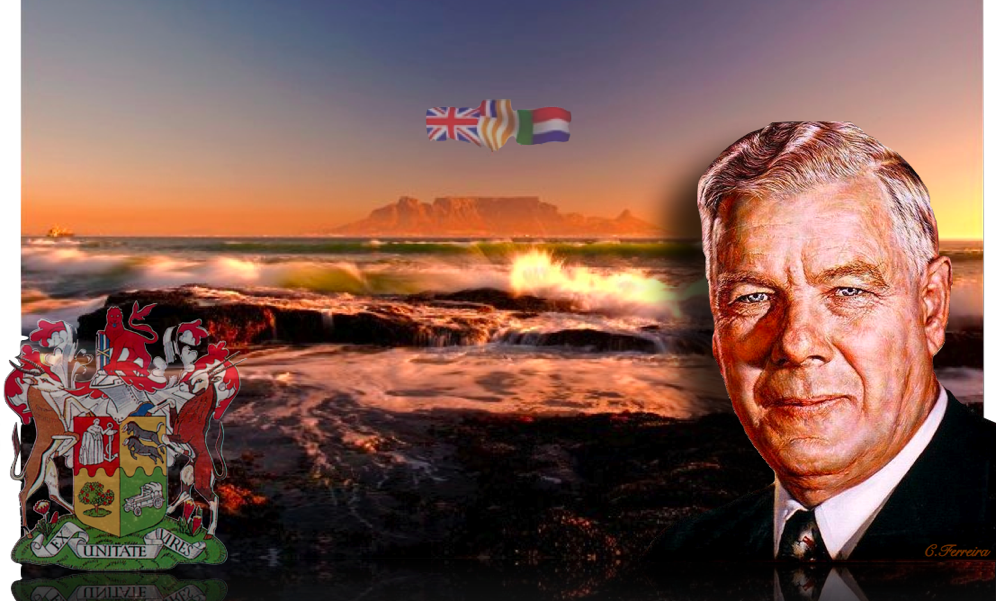
Speech by Dr HF Verwoerd, Prime Minister of the Republic of South Africa, on the Occasion of the First Quinquennial Celebration of the Republic of South Africa at Monument Hill, Pretoria, on May 31, 1966
Dear countrymen and fellow citizens,
The light of the sun of freedom was extinguished years ago, but not forever. In this Republic of South Africa we are once again abiding in the full strength of its light, in the warmth which it spreads; we are a free, happy and prosperous nation.
The light of the sun of freedom was extinguished years ago, but not forever. In this Republic of South Africa we are once again abiding in the full strength of its light, in the warmth which it spreads; we are a free, happy and prosperous nation.
We shall not have the privilege of gathering in this wonderful place every five years. Every fifth year we shall, however, celebrate the birth of the Republic. We shall do it because as a nation it binds us closer together in the unity we want, the unity which we must have in the face of the attacks surrounding us. But every fifth year we shall have the main celebrations in another part of the country. You are thus again tonight attending a unique event which the next generation will live to see here in perhaps twenty or twenty-five years’ time.
Where we are tonight so united in spirit and in our numbers, I want to point out to you the strength of an ideal, the strength of the human mind which precedes the deed. A nation without bearings, that does not know whither it wants to go, will not get anywhere; similarly so with a human being in his personal life. It is the choice of an ideal, an aim set clearly, which leads to victory in the end. And it is since the day that we, as a nation, set the Republic as an ideal, that we have been inspired with strength and progressed day after day in all spheres of life. The power of inspiration of the Republican ideal was not limited to the achievement of political freedom. On the contrary, it was the inspiration of all our deeds, it was the inspiration of our growth as a nation. It led to our unity, it led to our economic prosperity, and it was based on our faith in God. We placed our future in His hands and received the gift from His hands five years ago. My friends, the strength of an ideal is inexhaustible and it will inspire us still further onwards, but when we consider it we must glance back and think of those who laid the foundations.
Now I want to put you a question, and in order to prevent it from being too much confused by the emotions of our time, I want to put it as follows: If in future years one looks back on the history of the last sixty years, what will one see? My answer is quite clear that this observer of the past will see a heroic nation; a nation which could lift itself up out of defeat and rise to victory; a nation which did not remain defeated but which in spite of all the human weaknesses which it inherited like other nations, could yet rise out of its defeat and grow to greatness in all spheres of life. Greatness only exists when you can use your defeat as the foundation on which to build a future.
When the past is surveyed not only a heroic nation will be seen, but also how a clear future was unravelled out of an apparently inextricable crow’s nest. The two great streams of the history of the first sixty years of this century will be seen as two opposite streams; one which sought independence but an independence enclosed in a greater whole; a pursuit of an independent South Africa as part, firstly of the British Empire, and later of a Commonwealth. Independence, but within limits; the desire of a share in a greater unity.
Beside that was the second stream; that of a nation which wanted to become independent, altogether free of all ties, but at the same time on friendly terms with those to whom it was tied before. It was the stream of the birth of a nation; the stream of a republican form of freedom. On looking back one will see that the two clear, separate, even opposing streams, are symbolized by two groups of men. On the one side Generals Botha and Smuts and on the other side General Hertzog, Dr. Malan and Advocate Strijdom. Those who represented the first course, who also inspired to a form of unity for the nation, sought it in the rise of that unity; in accepting the fact that the weaker and smaller would find its salvation in what appeared to be an everlasting world power. On the other hand, in the second stream, there was also an aspiration to national unity, but a unity of the people alone, of those who belong together; those who are loyal to each other, loyal to their country and nation and after that loyal to everybody outside.
On looking back, the first road will be seen as the cul-de-sac and the second as the road which led to fulfilment - the republican road. But let me state clearly now that history will judge that the courses and events which were included in that first political trend - although the road led to a dead-end - were linked up with the main road. It was the smaller stream, the stream which also helped to frame the Union; a stream which originally included the idea of separating the races; a stream which within limits also sought independence. That stream, as a tributary, flowed into the main stream and helped to fill and give it capacity. In that sense I can acknowledge the contribution of that stream, with which I personally never could identify myself, to the events which are taking place today; as a tributary which flowed into the main stream and in the fullness of time helped to make possible the greatness and magnitude which we are experiencing today.
But my actual tribute must be paid to the main stream and its leaders; the leaders and the followers, the leaders and the nation. General Hertzog who started it; laid the foundation of the Republican ideal with his point of view, his aims and his endeavours. Although he later felt satisfied with the length of the road on which he was able to walk, he will remain – when in the future a survey is made of the past – the great and powerful architect of what has been achieved. After him came Dr. Malan, the prolonged leader of the republican aim and idea. In the Cape where the republican ideal was not so obvious as in the northern provinces, it was he who clinched the ideal so that when the time came we could stand side by side and make sure that what had to come, did come. Cautiously and calmly, according to his nature, he moved onwards. And then again at the right time that which was also necessary, was added – the ardour and the driving force of Advocate Strijdom, the fighting prophet who had to work to overcome obstacles, who had to work to so engrave this ideal on the heart of the nation that it could remain there indelibly; that it could not disappear but had to come to fulfilment.
My friends, we have much to thank these leaders for, but together with them we have undeniably much for which we have to thank the followers, who stood behind them right through the past six decades and were prepared to carry this burden until the day of fulfilment. The time of preparation lasted for sixty years, six decades. And then, like a flash of lightning, the Republic was there within two years! The preparation took a long time, essential details were settled, inspiration was given; but the right time had to come and when it came the nation and its leaders had to seize the hand immediately which history offered them. And it is the fame of this generation, we who are sitting together here tonight celebrating, because we did not fail; because we were ready at the right moment, ready at heart, united in our decision and courage to attempt the future.
I said that in the future we would be judged as a heroic nation. We proved that in those days in those two years of decision. In the five years of the Republic’s existence, we have proved that we can continue working onwards, but it was especially in those fateful months that we had to be prepared to act and did act!
Now I want to give expression to the often unexpressed longing of our people, that writers and poets may come into existence who can and will sing the praises of their own generation such as those of other nations in their hour of wonder. Oh, if it could also be granted to us as it was granted in the past to great nations in their hour of fame that those would come forward who do not ask hesitatingly. “what is a nation”, but who will cry out; “This is my nation, my nation is like this, thus it can do wonders, thus it can create its own future”. The writer and poet who can sing the praises of what is happening now will be quoted as long as the people of the Republic of South Africa remain. If out of our midst someone would come forward to sing the praises of the life of a nation, without hesitating to pay homage to patriotism, love of country, without following modern patterns which are the fashion elsewhere with nations who are already old, someone who in accordance with the fixed pattern of paying homage to his own people, could push aside what is carnal and ugly and see the spiritual, the beauty and the greatness in modern history and sing their praises! If only we could find such writers and poets of our time, how rich would we not feel? How rich would our people of the future be if they were told by such interpreters whom the heart of the nation feels today – five years after this miraculous event, this great milestone in the history of our people.
My friends, the Republic was once the one-sided ideal of many, but it has become the fulfilment for most. I dare say with great assurance that through these eventful five years many who were not prepared for this constitutional development in 1961, are now happy that it actually did come to pass. We have learned much in these five years. We have learned that we are, even if young, a nation in South Africa; that we all belong to that nation, that with pride we may say; this is our country, the country of all of us. Five years is an extremely short time for so strong a feeling to grow after the differences we had before. The amazing fact of life today is not that there are some who cannot yet accommodate themselves to this new era, but that so many can.
To the few who cannot yet accept this Republic as the best for South Africa and their own, there is so little to look back to, to hanker for. After all, in the past there was the link with the Commonwealth, which could be looked upon as a club of kindred spirits. It has become quite different, a conglomeration of nations, who do not understand one another in most respects. What is there to desire in that context? Let all who still cannot find it in their hearts to be wholly at one with us, realize this one fact of today’s history, and align themselves in future, whatever political objectives they may have, with us all as one nation, loving one country, prepared to defend her with all that we have.
There may be another group for whom I have no appeal and no comfort: those who would only accept the Republic if it were a multi-racial or even a Black or a “majority” Republic, as they would call it. Tonight I am not dealing with the wreckers, but with the builders. Those few who cannot see South Africa as it has grown and with all the grand ideals it also has for the others entrusted to its care, but seek to change all this into something wholly new, which would bring us to disaster and chaos as elsewhere in Africa – for them I have no word to say and with them I have no patience.
Let those of us who wish to be builders – and they are nearly the whole of this South African nation – for those of us who wish to be the builders let us continue to face the future with confidence and with hope. Let us be assured of success in the face of difficulties which we know are there. Briefly I wish to answer the question: What then is this Republic of ours, the Republic of the builders of this new nation? I can say at the outset that this Republic is part of the White man’s domain in the world. When viewed in terms of space, the White man’s domain in the world is fairly small; a tip of the great Asian-European Continent, Australia, New Zealand, great parts of the Americas, and this tip of the continent of Africa which is the anchor too of Western civilization. The White man and all that he has created for humanity through the past ages, is of incalculable importance for civilization and for history, and not only for history that has passed. He, and the spirit with which he is endowed, the characteristics which led him to this day and will in the future provide his inspiration, will always be needed where order and peace and progress are desired.
But, while we see this Republic as part of the White man’s domain, we are not unresponsive to the ideals of others. We see Africa, for example, as it is, a continent of many nations, each with its own degree of development, each with the form of government acceptable to itself, each with its own pace of progress – a continent of many nations, Black nations, and in the southern portion, White. If the world could only realize that this continent is no different from Europe with its many states and nations, and from Asia with its many states and nations! If it only could realize that in this Africa to which we belong, the differences are there and will remain there and must lead to the existence and co-existence of many widely different peoples and states. If only they could realize this, what great opportunities for better co-operation and better solution for all our problems we would then find! We are not insensitive to the ambitions of others. On the contrary we, who as a nation had to fight for what we have and who have achieved this freedom, cannot but understand similar ambitions in the breasts of others. Those who believe in their own nation and its separate existence are best capable of understanding the desires of others to achieve the same.
We understand the nationalism of each of the separate states of Africa. We understand the similar ambitions of the various nations and national groups at present within our own boundaries. And because of our own experience, we not only understand their ambitions, but would also wish to help lead them to fulfilment in the right way so that it can be an achievement not only for the selected few, a dictator or two, but for the masses, for their progress and their happiness.
This is a White republic, ruled by the white man, part of the white domain of the world, but with full understanding for the ambitions and objectives of the Black man of Africa within our own midst, our closest neighbours and those farther afield.
But this Republic is also a Republic of goodwill and friendship. We desire the well-being of all. We have no ambitions, in spite of what some say, to exploit others. Our nearest neighbours, the High Commission Territories, need have no fear. Those further away – states like Zambia, Malawi, many others farther north – need be neither jealous nor filled with fear that we have any intentions of attacking or exploiting them. The one principle we have laid down for ourselves is that we desire nobody to interfere with us, and that precept by which we wish to live, we intend to apply to others. We will not interfere in the development of Basutoland or Swaziland or Bechuanaland or Malawi or any other state of Africa. We offer goodwill, but we expect to receive goodwill in return. We will not interfere, but we will not be interfered with. And so this republic is a republic which is prepared to aid all those who need us but, since our hand of friendship has been struck aside so often, the initiative to obtain aid rests with those who need it. They must ask and we can give. We can give of our knowledge, that knowledge grown from the earth of Africa itself. We can give of our prosperity, plucked from the hard earth of Africa. Al that we possess we worked for. We are not prepared to provide handouts to buy friendship, but are prepared to aid those who wish to work for themselves. Who can keep their eyes off the possessions of others, who can keep their hands to the plough rather than outspread like beggars. We wish to help the process of self-development because no respect and no continued independence can be achieved without working hard and developing your own country yourself.
To the outside world we must also say that when the morality of our Republic is called in question, when it is said that we are not prepared to accept equality or assimilation with all who are in our midst, to them we must say that morality does not exist on the principle in which they believe, which they have experienced alone. Nations, various kinds of people who live close together, can solve that problem so easily called multi-racialism when there is a multi-national existence. I question the morality of forced assimilation or absorption of peoples.
It might be the way for some of the mighty nations of the world; it can be true that in the United States of America, its huge majority of White people can assimilate, in the course of time, the non-Whites in their midst. If that is their policy, if that is their way of life, who are we to question it? It is their problem, it is their country, those are their peoples and it is their future which they must seek themselves in their own way. Perhaps that may be the best solution there and in the United Kingdom, which has created a similar problem for itself, it may also be the right way to absorb and to assimilate, but is it the right way for a country like the Republic of South Africa? If we were to apply that principle of assimilation as if it were the only moral solution for our problems, what would happen to the White man whose heritage this South Africa is, settled by his forefathers, built by them throughout three centuries and more, a home for its people, drenched with their sweat and blood of these three centuries? Must the white population be assimilated and lost; must all that they possess and have gained be lost? Would this be right for them? Would this be right for the Coloured and the Indian minorities who would also have to be absorbed in spite of their differences, their own ambitions, partially their own religions? Must they be assimilated and lost? And for the Bantu, would it be right for them to become the dominating group, but in the course of that process to lose their various national identities and perhaps languages and customs and to suffer by being unable, as we know is the case, to direct and run and develop the degree of Western civilization this country has reached in the form of industrialization and more? Would this be right to their masses? The few who might attain power, may be satisfactory and may be wasters for all we know. The masses would become to great extent unemployed and the land desolated, as we have seen elsewhere in Africa. Would it be just to them? Would it be moral to create the semblance of freedom, but in fact allow living conditions of slavery?
True morality seeks another solution and that is the solution which this Republic is attempting today. It is the solution of doing right to all in the same way, by following the way that the nations of other continents have sought, namely of each going his separate road. To that we wish to add that we judge it our duty to help those, still far behind in civilization, along the road which for them will be long and difficult. We, the Republic of South Africa, would wish the major nations to have sufficient confidence in our honesty of purpose; in our deep desire to retain for ourselves what is justly ours, but to give to others even more than is justly theirs.
This is a Republic of peace. We seek peace, co-operation and friendship; we seek peace within our own country, and it is there. The extent of the co-operation from the various non-White groups has again come to the fore during these celebrations because they know what we wish for them.
We seek peace with our neighbours. If we are invited to the Day of Independence of Bechuanaland or Basutoland or whichever territory might wish our presence, we will be there. We seek peace and friendship with the great nations of the world. We will, however, not sacrifice this Republic and its independence and our way of life. If we are forced to by aggression, we will defend it with all that we have at our disposal. We will bring to the altar our lives, our wealth and all our possessions. This Republic is not simply to be taken away from this new nation which has come so far and is so proud of what it does possess.
We offer to our immediate neighbours co-operation and goodwill. We do not wish to exploit their interests in the form of any type of economic colonialism. We would rather see them develop on their own and in full control of what is theirs, and must remain theirs in our view, just as what is ours must remain ours according to the same policy. We offer to all the other states the same goodwill and the same co-operation. We offer to the Western nations, big and small, that friendship which we believe should accompany the kinship which we feel with all of them. If this hand of friendship is not welcome, it is not the fault of this Republic, which is built on the high values, the high moral values, which Western Civilization has created through centuries and centuries of endeavour.
And now my friends, what about the future? It is easy to foretell the future in the material field. Economic development can be vast. The conditions are there; the raw materials exist, the people are there. Concerning this I have no doubt. I do not want to elaborate on that tonight. I have equally little doubt about the solution of our racial problems, if given the time. If meddlesome people keep their hands off us, we shall in a just way, such as behoves a Christian nation, work out solutions in the finest detail and carry them out. We shall provide all our races with happiness and prosperity.
The problem of the future, however, lies in the international field, because it is not in our hands. We have a road on which we have to walk ourselves. If we can make the nations of the world understand that we are honest and sensible in our aims, then here also I have no doubt. If, however, they should want to sacrifice us and break us down because of their own selfishness in order to get support for their own purposes – not in fairness or with any moral considerations but as the victim of their ambition – then the future for us in the international field would be dark. But I cannot believe it. I cannot believe that in the end the common sense of the human race will not triumph over self-interest. Therefore, I hope that our voices, wherein we bear witness to our good intentions towards all states and people, will extend to all the world so that it will come to its senses and protect us from international pressure and attack.
If that should be the case then a golden age lies in store for South Africa, this Republic. Then we may ask the question: What do we intend making of that golden age? Only strong legs are able to carry a heavy burden. Are our legs as a nation strong? Shall we be able to build up great spiritual values out of our prosperity if we are safeguarded against attack and adversity? Shall we become contributors to art and science? Shall we keep our faith or shall we become spineless like some other nations in their prosperity? This depends on the character of our people.
If we as parents and educators use correctly the opportunity which we have, then we can build a great and mighty nation out of this young one. We will: that is my hope and my belief. I believe in our nation. I believe in our inner strength. There have been weaknesses of discord, and others – so often pushed to the fore – which are perhaps still there. But in spite of that we have grown, built, developed and conquered. Why will those characteristics not stay with us and lead us to further growth and victories? I believe that we will do it, and therefore I have an unshakeable faith in the future of our nation.
This Republic did not come into being easily or quickly. Anything built in a hurry is easily broken down. New states that are continually disintegrating have come into being. Anything that grows slowly is not destroyed easily.
Our republic has grown slowly; there were sixty years of preparation and now there have been five years of building up. Signs exist which show that the work can be continued in this way. Our slowly developing state has developed an inner strength; but more still, our state is built on self-sacrifice. The blood of brave men and women has drenched our earth. Those sacrifices burn in the life of a nation like a fire, a fire which is never quenched. Whenever difficulties arise the flame flares again, although it may burn low in the times between.
The fire that steels the hearts of people, will make us stand our ground. We shall continue to dedicate ourselves wholeheartedly to our people and our fatherland. The Republic of South Africa has all our devotion, whether it be in times of fame or grief, in difficult or prosperous times. We dedicate our strength and our lives to this Republic of South Africa.

